
Could, or Should
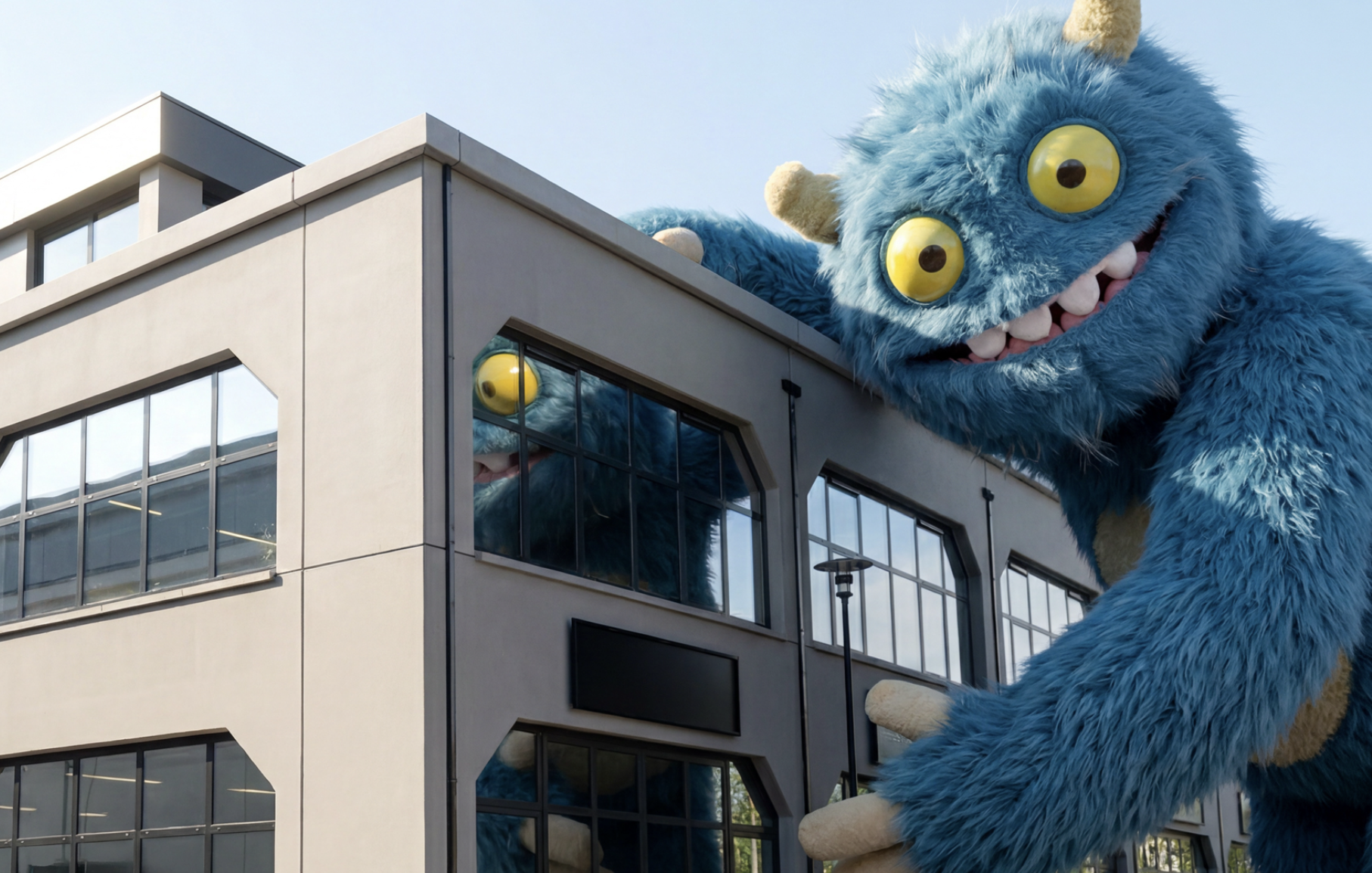
Our Google Search image. The building is real, the monster is a puppet, AI did the part in between.
The short version. We asked Dutch marketers who use AI every day whether the last time they reached for it the result came out cheaper, faster and better. Almost none said yes to all three. Usually faster. Rarely better. Not one of them said they chose AI because it was the best tool for the job. Below is what we heard. And what a year of building AI visual systems for brands like bol taught us about why this keeps happening.
Lately almost every brief that mentions AI arrives the same way. There's a job that sounds quick and cheap. Someone reaches for AI because the word itself has come to mean exactly that. "We need these products colour-swapped across five sizes, just book the AI content creators." The want is everywhere. What's gone missing is the why.
That's the thing we keep running into. The question is rarely whether AI could do something, because it usually can. The question is whether it should be the tool for this particular job. Those are not the same questions and the gap between them is where most of the frustration with AI actually lives.
Underneath nearly every AI project that goes sideways sits one quiet mistake. People treat AI like Photoshop. They picture a tool that edits, that you can nudge and correct and fine-tune after the fact but a model like Nano Banana Pro doesn't edit anything: it regenerates. Ask it to change one thing and it rebuilds the entire image from scratch. On paper that's a small distinction but in practice it makes all the difference. Almost every problem we encountered flows straight out of it.
Why a colour swap is never just a colour swap
Take that colour-swap request. It came from a large retailer and on the surface it sounds like the simplest job imaginable. Change a product's colour, leave everything else alone. In Photoshop that is exactly what you would do with some tweaking. In a generative model it doesn't work the way the word "swap" implies. The newer tools will tell you they can edit one area and leave the rest untouched. Sometimes they get close but on product-accurate work, in our hands, asking for one change quietly rebuilds far more than you wanted. The model reconstructs the image rather than truly preserving it. The original detail drifts and you think you are swapping a colour. In practice you are regenerating the picture and hoping it lands close enough to the original with the changes you asked for.
Every regeneration costs you because the detail softens, colours go mottled, the result drifts a little further from the source with each pass. In our own work we see roughly three percent of detail and sharpness lost on every round commanding the same prompt. The closest thing most people will remember (if old enough) is copying a videotape, then copying the copy, then copying that. A little is lost every time until you are left with something muddy that nobody asked for.
So we pushed back, which is not what a team chasing quick and cheap wants to hear but pushing back wasn't the end of it. We did the job, just not the way it was requested. We used AI for the one thing it was genuinely good at here, generating the new colour along with the light and shadow it would realistically cast. Then we went back into Photoshop and masked the original products back in by hand, so the real detail survived while the new colour's bounce light and shadow sat correctly around it. The AI handled the lighting. The craft handled the detail. Married together it held up, where the one-click version would have shipped mottled and nobody would have quite known why.
Why "just rotate it two degrees" breaks it
The same misunderstanding shows up from the other direction too. On another job we had generated a range of images, product-accurate, sitting in an on-brand environment. They came out genuinely well. Real reflections, correct textures, the logo right. The hard part was done. Then the feedback arrived. Rotate it two degrees. Tuck those other products in ever so slightly.
In a Photoshop world that's a thirty-second nudge. Here it's a trap with two exits, both bad. You can start over and re-prompt and hope, knowing the whole image will change and you will probably lose everything that was already right. Or you can feed the image back as a reference and try to micromanage the composition, which fails for two reasons at once. There is the degradation again. These tools can swing a camera angle around now, which is a real feature but a small, exact, predictable nudge is a different thing entirely. Models cannot judge degrees or percentages at scale. Ask for two degrees and you tend to get forty-five or a whole new perspective. It does move, just never the amount you asked for. There is still no knob to finetune, no real sense of "a touch."
A fair caveat before anyone writes in: this is where the tools stand as we write this. The field moves fast though and it is entirely possible that by the time you read this a model has shipped that has a proper handle for exactly this. The point is not that AI can never do this. It is that right now, on the jobs landing on our desk, reaching for it as if it already works that way is what gets teams into trouble.
This is the part that catches people out. AI gets reached for because it sounds faster and cheaper and for plenty menial jobs it honestly is. But the instinct, when something isn't quite right, is to grip tighter and steer it down to the degree the way you would steer a designer. With this tool, gripping tighter is exactly what breaks it. The more precisely you try to control it after the fact, the worse it gets. That is the opposite of nearly every other tool in the building.
What actually works
The analogy we keep coming back to ourselves is painting with oils, which is ironic for a tool people reach for to save effort. You plan before you commit because once it is on the canvas, changing it is far more work than getting it right the first time. Both of the stories above went wrong for the same reason. People tried to change things after they were already on the canvas. The discipline is to move the thinking to before the canvas instead of after. Editing after the fact is Photoshop logic. Planning before you start is painting logic and truth be told is simply that AI rewards the painter.
In practice, three things make most of the difference in our work.
Brief the model like you're explaining something to a child, and be exhaustive. A model does exactly what you ask and fills in the rest freely, especially with images. That sounds contradictory, but the more freedom you leave it to invent, the worse the result usually gets. What would be a good brief for an agency is the bare minimum for a model. Think lighting, material, texture, mood and the scale of the subject. It also helps to have a reference image described back to you in technical specifications, then feed that into your prompt.
Decide what you want before you start. Changing only the colour of someone's socks? Use terms like "only change" and give it a hex code. Most models can hold colour accurately now, which is what keeps a result on brand. Say what must be preserved too, for example "maintain composition." Decide all of this upfront, because every extra round of edits costs you detail and invites the model to drift and invent.
Plan where AI stops. Every round of edits is a concession. Sometimes an image is almost there and the model simply cannot carry it the last stretch. Don't keep trying. It may mean sourcing a reference, generating the product separately, generating the setting separately, then bringing them together afterwards. That final assembly can happen inside the model, but more often than not it belongs in Photoshop.
What we are hearing
We put this to a group of Dutch marketers and brand people who work with AI in real projects. It's a small, honest sounding rather than a national poll. But the pattern in it was hard to miss, because nearly everyone recognised the same thing.
Here is the part that gives it teeth. Most of the people we heard from aren't AI-sceptics standing on the sidelines. A majority told us AI is already built into how they work day to day. When asked whether the last time they reached for it the result came out cheaper, faster and better almost none said yes to all three. The rest got cheaper or faster but not better and a couple said the result was honestly worse than not using AI at all. So this isn't refusers complaining about a tool they avoid. It's the adopters telling us it usually isn't making the work better.
The why sits right next to the what. When we asked what drives the choice to use AI, nearly everyone pointed at saving time, with one honest soul admitting it was about looking innovative. Not one person said they reached for it because it was genuinely the best tool for the job. A good share told us plainly that AI often gets picked on a general feeling that the team should be using it, rather than a real reason. The want running well ahead of the why.
One respondent put the whole hype problem better than we could:
“Everyone acts as if anything is possible with AI, but once you dig in it turns out not to be. And the 'experts' agree. They always say: in six months it'll probably work.”
Another answer read less like a survey response and more like a case study. A brand-side marketer described being told by an agency that AI would solve a tight production budget. They'd flagged upfront that the work was too specialist for it. They were talked into trying anyway. It went badly enough that the team has since pulled its marketing and communication work back to people they trust. Their point stuck with us: even a straightforward production needs human eyes checking every frame against reality and the rules, let alone something you're trying to prompt into existence. It is the colour-swap story again, told from the client's side by someone it happened to.
The counterweight was just as useful. A lead at a consumer brand uses AI genuinely well. For research, for reports, for getting up to speed in areas outside her expertise. She rates the results highly. But not for creative work, where she reaches for it only to test or sketch. That isn't a contradiction of everything above. It's the sophisticated version of it: AI pointed at the jobs it's actually good at, kept away from the ones it isn't. Deliberate, not reflexive.
Every voice in our survey pointed the same way. The teams having a good time with AI are the ones asking should before could, then choosing where to let go.
Where this comes from
Over the course of a year we worked intensively with virtually every model available, for bol and later for Ziggo. It was a large-scale exploration, driven by a simple problem: there were not enough hours in the day to shoot the volume of content needed. Working as a tight team, we built a system that holds up on brand. So none of this comes out of thin air, it comes out of the work itself.
We don't believe in AI experts, for what it's worth. The field is too fluid and it rewrites itself too quickly for anyone to claim that title honestly.
Before the canvas, the plan
None of this is an argument against AI mind you. We use it every day and pointed at the right job, prepared properly, it takes us places we could not reach by hand or by prompt-spam alone. Our argument is for the question. Before the want, put the why. Before the canvas, the plan. The teams who win with AI are not the ones using it for everything. They are the ones who know when to use it and how much to let go once they do.
That discipline is the work we do. At Studio Yukon we build campaign worlds and steer visual systems for brands where the output has to hold up on brand, at scale, every time. Sometimes that means we find AI has a place in the trajectory and it does the heavy lifting. Sometimes it means keeping it well away from the part that matters. Knowing which is which is the whole job.
If you have questions about any of this, want to put our experience to work on a problem, or are simply curious what we do, get in touch with Jordy at jordy@studioyukon.com, or take a look at what we stand for and the work we’ve done.